GoWarm Work · Project tracking

Project tracking for companies with nobody to maintain it.

Every project tool assumes someone keeps it honest — a project office, a scrum master, an admin. Under 500 people that person does not exist, so the plan drifts out of date and everyone goes back to the spreadsheet. GoWarm Work puts the discipline in the structure instead.

What is the best project tracking software for a small business?

The useful question is not which tool has the most features, but which one survives having nobody to maintain it. Under 500 people there is rarely a project office or an administrator whose job is keeping the plan truthful. Look for structure that enforces itself: a task that cannot close without evidence attached, a gate that holds the next stage shut, dependencies checked when drawn, and a baseline frozen at the start so drift is measured rather than renegotiated.

The tool is not the problem. The maintenance assumption is.

Pick any well-known project tool and it will do what a small company needs on the day you set it up. The question is what it looks like in the third month, when the team is busy and nobody has updated a date in three weeks.

Updating a project tool is a separate task, and separate tasks compete with the work they describe. That competition has a predictable outcome: the record is maintained best when the team is idle and worst when the team is under pressure. Which is exactly backwards, because the quarter where you most need to know what is happening is the quarter where the record is least trustworthy.

A plan whose accuracy is inversely proportional to how much you need it is not a plan. It is a document that agrees with the present.

The second failure is subtler and does more damage. Most tools generate work: recurring tasks, reminders, alerts, weekly digests. The pitch is that the system will keep everyone honest. The mechanism is that the system manufactures items and assumes a human clears them. Generated items arrive on a schedule; attention does not. Once the queue passes the length that can be read in a sitting, it stops being read at all — and from that moment the tool is reporting on itself rather than on your projects.

Neither failure is fixed by training, by picking a different vendor, or by asking harder. Both are structural, so the correction has to be structural too.

What replaces the person you do not have.

Four mechanisms, each doing a job that a project office would otherwise do by hand.

How a project holds its shape without an administrator Stages run left to right with a gate between each, holding the next stage shut until the current one is met. Underneath, the baseline frozen at the start is shown against the actual dates, with the difference between them labelled as measured drift. A task closes only when evidence is attached. STAGES AND GATES Design gate Build gate Handover PLAN VERSUS ACTUAL Baseline frozen at start Actual drift, measured closes with evidence

The baseline is frozen when the project starts and never re-fitted, so the gap between plan and reality is a number anyone can read rather than a monthly renegotiation.

Gates hold the next stage shut

A stage does not open because the calendar says so. It opens when the current stage is genuinely met. That single rule removes most of what a project manager spends their week doing, which is finding out that step four started before step three finished.

Dependencies are checked when you create them

Task dependencies are validated for circularity at the moment they are drawn, not discovered when the schedule refuses to resolve and you are already late. A small thing that saves an entirely avoidable class of problem.

The baseline is frozen at the start

Dates move — that is normal. What is not normal is having no record of what they were. With the original plan frozen, drift is a measured difference. Without it, every date change quietly rewrites history and the project is permanently on schedule right up until it is not.

Why it matters: a plan that is re-fitted each month cannot be wrong, which also means it cannot tell you anything.

Evidence closes a task, not a declaration

A step marked done by the person responsible for it is an assertion. Attach a file, a link, or a note that cannot be quietly rewritten, and it becomes a record. This is the mechanism that makes a status report worth reading six months later.

Half your work never finishes. Most tools cannot say so.

Work has two independent questions: whose is it, and does it end. Customer or internal is one axis. Timeboxed or standing is the other. All four combinations are ordinary — an implementation with a go-live, an internal migration with an owner and a date, a managed-service retainer, and a standing capability such as training, compliance or upkeep that has no end and never should.

Tools that only model finite projects force the standing half into a permanently open item. That item then sits in every count you look at: percentage complete, overdue tasks, projects at risk. One never-closing retainer is enough to make the whole dashboard meaningless.

In GoWarm Work standing work is retired, not completed, and stays out of the statistics that are about delivery. It is still tracked, still logged against, still visible in the manager rollup — it simply does not pretend to have a finish line.

Timeboxed

Has an end date and a definition of done. Gets a frozen baseline, gates between stages, and drift measured against the original plan.

Standing

Never completes. Retainers, maintenance, compliance, training, facilities. Tracked and logged against, but excluded from delivery statistics.

If the project has a bill, the bill belongs on the project.

Bill of Quantities is a first-class part of a project here, not an export into a spreadsheet that immediately diverges from it.

Progress is recorded as increments rather than running totals. Every entry snapshots the rate it was booked at, so a rate change later does not silently rewrite what was already done. A mistake is corrected by a reversal that points at the original rather than by an edit — because a spend ledger you can edit is not a ledger. Approved variations stay separate from the original bill, so the reason a project grew is legible instead of absorbed into it.
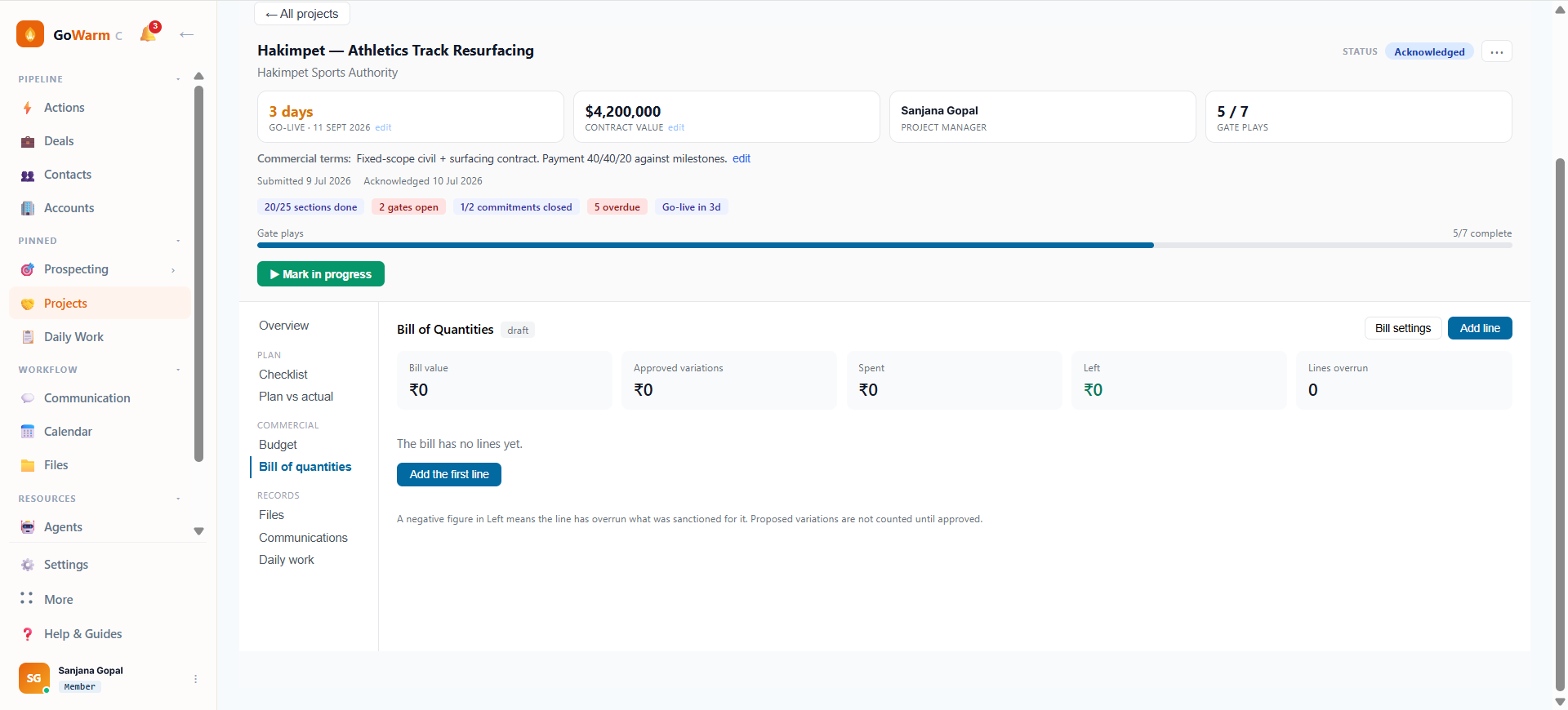
Bill of Quantities in GoWarm Work, showing bill value, approved variations, spent, remaining and lines overrun as separate figures
Bill of QuantitiesPlanned against booked, entry by entry, with approved variations counted apart from the original bill. A negative figure in Left means that line has overrun what was sanctioned for it.

This is ordinary practice in construction and civil work, and almost entirely absent from software-first project tools. It is also the clearest signal that this product was not designed for engineering teams and then pointed at everyone else.

Who this fits

Companies up to about 500 people, in any industry. What they share is not size but a gap: nobody's full-time job is keeping the record of work truthful, so the founder or managing director has quietly been doing it instead.

Construction and interiors

Sites, stages, gates and a bill of quantities that behaves like a ledger, with variations kept apart from the original bill.

Engineering and manufacturing

Long builds with real dependencies, where the plan needs freezing at start and the difference measured rather than re-planned each month.

IT services and agencies

Fixed-scope delivery and open-ended retainers side by side, without the retainer sitting at ninety per cent complete for two years.

Professional services

Engagements where the evidence matters as much as the completion, and closing a step needs something attached to it.

Facilities and field service

Standing responsibilities that never complete, alongside the finite jobs that do, counted separately because they are different questions.

Internal functions

Data, marketing, finance and delivery teams whose work is real but appears in no pipeline, and lives in a shared sheet nobody trusts.

$999 a month, up to 25 users.

A flat monthly price for the team, not per seat, so adding a person doesn't change the price until you pass the 25-user limit. Above 25 users, pricing is custom. No sales module needs to be enabled. If you want GoWarm CRM as well, both products together are $1,499 a month for up to 25 users.

Questions we get asked

Do we need a project manager to use this?

No, that is the design assumption. Gates, dependency checks, a frozen baseline and required evidence do the work an administrator would otherwise be doing. Setup is your departments, schedules, holiday calendar and a first activity list.

How is this different from Jira, Asana or Monday?

Those assume somebody maintains them. This assumes nobody does. It also models work that never finishes as its own mode, rather than a permanently open ticket that distorts every count.

Does it work for non-software teams?

Several features exist because the first users were not software teams — Bill of Quantities, standing work, evidence required before a step closes. None of those are software-team concerns.

How long does setup take?

Most teams are running within a week. The activity list is meant to be edited in the first month rather than perfected before you start.

Can we import an existing plan?

Yes — a project checklist can be imported rather than typed in, and the baseline is frozen at the point you commit the plan, not at the point you first created the project.

Is our data separate from other customers?

Yes. Every organisation is isolated, and modules are enabled per organisation, so nothing you have not bought is running against your data.

Bring one project you cannot see clearly.

Twenty minutes, your own work, no slides. We set up one live project with its stages and its bill, and you decide whether what comes out is a record you would actually read.

Book a walkthrough Free · 20 min · No obligation